


This essay is adapted from Travis’ presentation at the “What Do Religious Traditions Offer the Left?” session of the DSA 2021 Convention this week.
“Of all the modern economic theories, the economic system of  Marxism is founded on moral principles, while capitalism is concerned only with gain and profitability . . . “
Tenzin Gyatso, His Holiness the 14th Dalai Lama, spiritual leader of the Tibetan people, made this statement in 1993, and has many times since reaffirmed his status as a self-described “half-Marxist, half-Buddhist.” The Dalai Lama is convinced that the path to what he calls a “nirvana of society” travels through socialism.
Or, as the Vietnamese Buddhist monk Thich Nhat Hanh, who coined the term “socially engaged Buddhism” during the Vietnam war, puts it, “Aware of the suffering caused by exploitation, social injustice, stealing, and oppression, we are committed to cultivating generosity in our way of thinking, speaking, and acting. We will practice loving kindness by working for the happiness of people, animals, plants, and minerals, and sharing our time, energy, and material resources with those who are in need. We are determined not to steal and not to possess anything that should belong to others. We will respect the property of others, but will try to prevent others from profiting from human suffering or the suffering of other beings.
With these antecedents in mind, I propose that Buddhism has fourkey strengths to bring to the socialist movement. These include the following:
- Training in mindfulness as an antidote to the incessant activity that drives so many of us socialists–but a mindfulness grounded in sila (morality), not just mindfulness to ensure personal focus for success in secular pursuits, as in the current mindfulness fad in popular culture
- An alternative worldview that offers sustainability, degrowth, and mindful planning instead of the “grow or die” philosophy and reality of the desire and consumption machine that is capitalism. Buddhism and socialism together form a dharma and a social model well-suited for the Green New Deal
- Skills and insight to counter overwork and burnout or, as former San Francisco Zen Center abbot Shunryu Suzuki used to say, “In the Lotus Sutra, Buddha says to light up one corner—not the whole world. Just make it clear where you are.” East Bay meditation teacher Mushim Patricia Ikeda,in her “Great Vow for Mindful Activists. Urges practitioners to say, ” “Aware of suffering and injustice, I am working to create a more just, peaceful, and sustainable world. I promise, for the benefit of all, to practice self-care, mindfulness, healing and joy. I vow to not burn out.” We develop these skills and insights, even as many of us try to emulate the bodhisattva ideal of postponing our own entry into nirvana until we are all enlightened, till not a single being is left behind. This is solidarity on a cosmic scale.
- Learning to love our opponents on the field of conflict and to not demonize them, aware that the system of capitalism is our true enemy and that demonizing its adherents often drives away more potential allies than it attracts
Despite the statements of the Dalai Lama and Thich Nhat Hanh, Buddhists are not united in their embrace of socialism as the next step for human society, far from it. The historical legacy of some secular socialists’ and communists’ hostility to Buddhism and other faiths has left deep, lingering scars. More common in the United States, though, is the idea among many Buddhists that a philosophy of nonviolence precludes conflict.
It doesn’t.
As that famous non-Buddhist Frederick Douglass said, “There is no progress without struggle.” In other words, there is no labor movement, no civil rights movement, no feminist movement, no Burmese monks turning their alms bowls upside down to show their disdain for the actions of the ruling military government, no wholesale exposure of the awful toll of corporate greed. As Martin Luther King, Jr., said, “We who engage in nonviolent direct action are not the creators of tension. We merely bring to the surface the hidden tension that is already there.” These hidden (and not so hidden) tensions are what socialism can bring to Buddhism. The synthesis can bring lasting change.
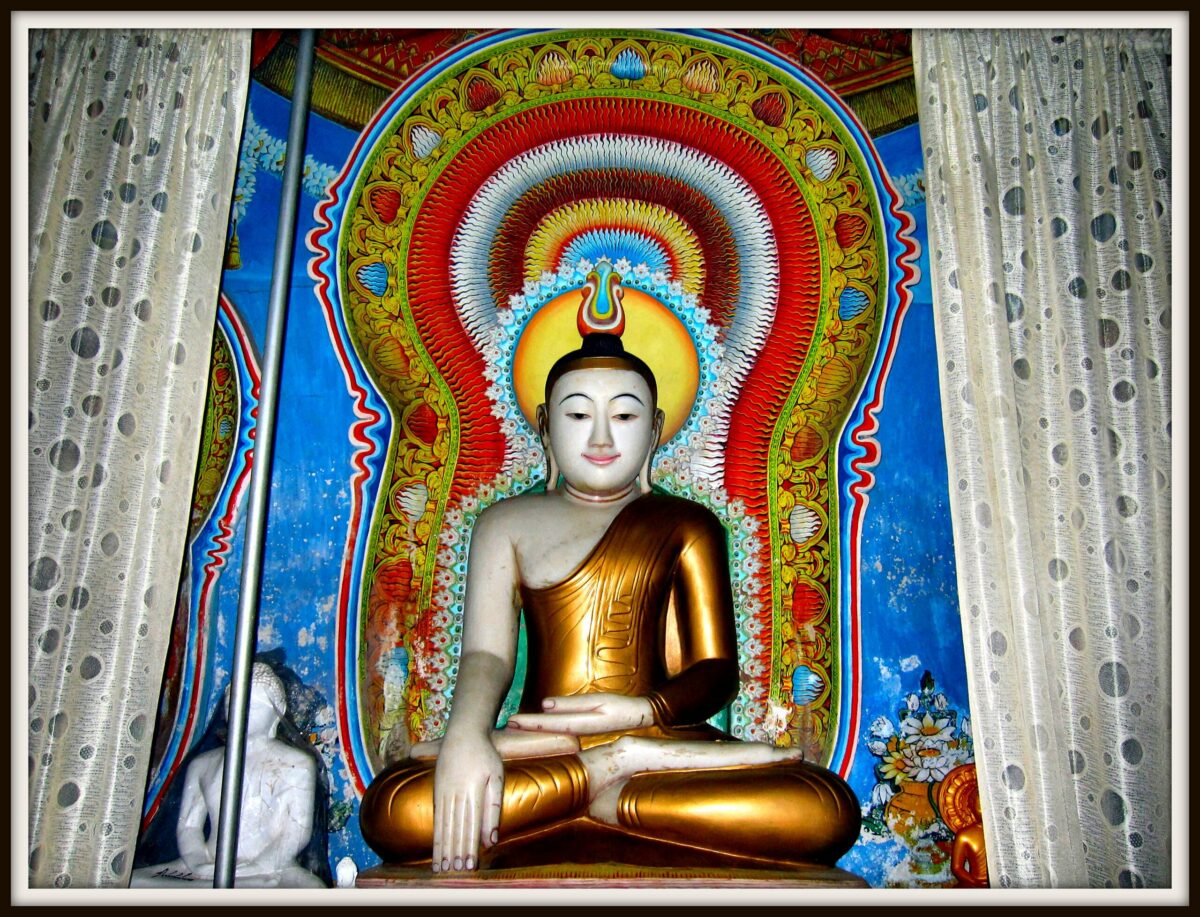
Image: Ron Saunders via Wikimedia Commons
Travis Donoho is a charter member of DSA, a founding member of Austin DSA, Knoxville-area DSA, and the DSA Buddhist Circle. He is a retired organizer with Communications Workers of America, American Federation of Teachers, and National Education Association in Texas and Oklahoma. This article is adapted from a talk included in the December 5, 2022 DSA Zoom meeting, "Solidarity, Rest & Community: A Winter Celebration of the Labor Movement, the Solidarity Is Brewing Campaign, & Our Community."
More →